Level 6-10


ᛋᚴᚢᚴᚱ ᛁᛋ ᛚᛁᚠᛅᚾᛏᛁ. ᛚᛁᚠᛅᚾᛏᛁ, ᛋᛁᚴᛁᚱ ᛁᚴ
ba-THOO-te-ron pro-kho-ROO-men, kse-NO-te-ron GI-ne-tai
“The forest is alive. Alive, I say!"
Wolfcat 🔍
| Medium | Beast | Chaotic | Level 7 |
How to encounter: |
In dense forest areas and mountain ranges. |
Armor Class: | 16 |
Hit Points: | 65 |
Speed: | 45 feet |
STR | DEX | CON | INT | WIS | CHA |
15 | 18 | 13 | 14 | 12 | 14 |
+2 | +4 | +1 | +2 | +1 | +2 |
Weakness: Fire attacks
Skills: Passive Stealth 17
Senses: Dark sight 180 feet
Languages: Animal speech
XP Gain: 550
Actions
Ambush: Piercing attack, +5 to hit, reach 5 feet, Hit 14 (2d10+4).
Utilizing its naturally high Stealth, the Wolfcat makes an Ambush Attack, which counts as a critical attack if the player is surprised. It bites or slashes at its target, then tries to create distance by triggering its bonus action, Nimble Escape.
Bonus Action
Nimble Escape: After a successful Ambush attack, the Wolfcat can make a DEX 16 saving roll to perform its Nimble Escape action. If successful, the Wolfcat distances itself from the target by 45 feet. The result of its DEX saving roll also determines its passive Stealth for the moment that you can overcome with a Perception check, potentially making it extremely hard to detect again and allowing it to launch a new Ambush attack.
Wolfcat Dash: Slashing attack, +4 to hit, reach 5 feet, Hit 12 (2d8+4).
The Wolfcat moves fast and straight towards its target, leaping to it and dealing damage with its claws. Make a STR 14 saving roll or be knocked prone for 1 turn.
Vigorous Bite: Piercing attack, +4 to hit, reach 5 feet, Hit 14 (2d8+6).
The Wolfcat moves fast and straight towards its target, leaping to it and dealing damage with its claws. Make a STR 14 saving roll or be knocked prone for 1 turn.
Origin
If your great-grandfather is still alive, he will remember a time when there were no Wolfcats at all. Created by druids during the Great Druidic War and utilized as weapons, these creatures began roaming the forests once the war ended. Sometimes, they even find their way into cities and towns. The Wolfcat is a perfect example of what druids are capable of creating. It is biologically sound, and the Wolfcat lives its life like any other (larger) forest beast. The war ended, but the weapons didn't disappear. They became part of the ecosystem.
Crow Bear 🔍
| Medium | Beast | Neutral | Level 7 |
How to encounter: |
In dense forest areas and mountain ranges. |
Armor Class: | 15 |
Hit Points: | 75 |
Speed: | 40 feet |
STR | DEX | CON | INT | WIS | CHA |
15 | 14 | 16 | 8 | 8 | 6 |
+3 | +2 | +3 | -1 | -1 | -2 |
Resistance: Melee damage
Skills: Athletics +5
Senses: Dark Sight 180 feet
Languages: Animal speech
XP Gain: 750
Actions
Bear Claw Attack: Slashing attack, +3 to hit, reach 5 feet, Hit 7 (2d6+3).
Bear Bite: Piercing attack, +3 to hit, reach 5 feet, Hit 6 (1d10+3).
If successful on an AC roll, the Crow Bear will try to pin you down as a bonus action. You must make a 14 Dexterity saving throw or be pinned down by the Crow Bear, taking an additional 5 damage. On your next turn, roll the Dexterity saving throw again to escape from the Crow Bear before you can attack it, unless you have a dagger and can reach it (DEX 12 roll) to make a melee attack.
Not Giving Up: When a death blow is delivered. The Crow Bear attempts a final strike to the nearest enemy with Bear Bite.
Origin
It is said that these creatures were created through transmutation magic, crossing different animals to create a new type of beast. Rumor has it they originated from the work of a mad wizard named “Peer,” who delved into arcane biology, magical genetics, and ethically questionable experimentation.
ᛗᛟᛟᚱ ᛒᚢᛚᛚ
Moor Bull (Red Herd) 🔍
| Large | Beast | Chaotic Good | Level 7 |
How to encounter: |
In forest areas near or in open clearings. |
Armor Class: | 14 |
Hit Points: | 65 |
Speed: | 25 feet |
STR | DEX | CON | INT | WIS | CHA |
15 | 12 | 16 | 12 | 14 | 12 |
+3 | +1 | +3 | +1 | +2 | +1 |
Resistance: Earth Magic
Weakness: Bludgeoning damage
Skills: Mining (kind of)
Senses: Keen Scent 300 feet
Languages: Coblyn
XP Gain: 100
Base Perks
❶ Seldom Alone: Before proceeding in the encounter you must roll a d20 to determine the Red Herd group size.
Actions
Trample: Bludgeoning attack, +4 to hit, reach 5 feet, Hit 1d8 per Moor Bull, up till a maximum of 4 bulls that can hit you.
First, roll 1d8 to determine how many Moor Bulls are storming your way. A maximum of 4 bulls can hit you. The Moor Bulls deal serious trample damage as they charge past. You can make a DEX 14 saving roll to take half damage. You must make a separate saving roll for each bull that comes your way.
Horned Away: Piercing attack, +5 to hit, reach 5 feet, Hit 12 (2d8+2).
The Moor Bull storms toward you, attempting to hit you head-on. On a successful hit, the Moor Bull launches you into the air. Make an Acrobatics 13 check to avoid being cartwheeled through the air and landing prone for 1 turn.
Horn Ram: Bludgeoning attack, +4 to hit, reach 5 feet, Hit 11 (2d8+4).
The Moor Bull swings its head towards your side, attempting to strike you with either its left or right horn and knock you over. Make a DEX 14 saving roll or be knocked 10 feet away.
Origin
Travellers speak of monstrous red bulls lurking in the forests and across the high moors. They tell stories of their terrible horns, thunderous hooves, merciless charges and flesh eating tendencies. Yet those who have lived among them tell a different tale. The Moor Bull is surprisingly friendly. Well... it is still quite territorial. But it won't harm you unless repeatedly provoked or directly attacked. Moor Bulls always move in herds. Hence, they are called “The Red Herd.” Encountering one by itself almost certainly means it is in distress, wounded, sick, or something else has happened that has cut it off from the herd — or it is the last survivor. Passing a Red Herd will earn you many soul-piercing looks from these mighty bulls. Come too close, and they will stomp and grind their hooves, letting you know that you have entered their territory. It is wise not to test their patience.
᚛ᚐᚁᚆᚐᚉ ᚃᚆᚔᚐᚅᚓ᚜
Wild Dwarfs 🔍
| Medium | Dwarfs | True Neutral | Level 8|
How to encounter: |
In and near rock shelters in deep forest areas. |
Armor Class: | 15 |
Hit Points: | 75 |
Speed: | 20 feet |
STR | DEX | CON | INT | WIS | CHA |
16 | 14 | 18 | 14 | 15 | 10 |
+3 | +1 | +4 | +2 | +2 | 0 |
Weakness: Piercing attacks
Skills: Survival +4
Senses: Dark Sight 90 feet
Languages: Dwarfish
XP Gain: 1000
Actions
Club Strike: Bludgeoning attack, +4 to hit, reach 90 feet, Hit 12 (2d10+2)
The Wild Dwarf puts its entire body weight behind its club strike in an attempt to knock you unconscious. If the attack hits, you must make an additional DEX 10 saving roll or be knocked unconscious for 1d4 turns.
Wrestle: Bludgeoning attack, +4 to hit, reach 5 feet, Hit 4 (1d8).
The Wild Dwarf attempts to wrestle you to the ground. Make a STR 16 saving roll or be wrestled to the ground. Once on the ground, if you are trained in wrestling or similar martial arts, you can make an opportunity attack. Otherwise, you will be restrained for 1 turn and must wrestle the Wild Dwarf off in your following turn.
Spring the Trap: Bludgeoning attack, +5 to hit, reach 5 feet, Hit 0.
It suddenly jumps to a bush and springs a trap the Wild Dwarf has set. Make a DEX 14 saving roll or a robe will successfully wrap around your left or right foot and drag you 10 feet away and then 10 feet upwards. This attack can be done twice.
Origin
If you come across a pack of Wild Dwarfs, then you are almost certainly dealing with outcasts, rebels or exiled members. Seldom still owning or wearing their armour, they have resorted to what the forest offers and are essentially a higher-class version of cavemen. But Wild Dwarfs are not simple-minded. They are often extremely knowledgeable and passionate, and although they would not easily admit it, they are eager to redeem themselves.
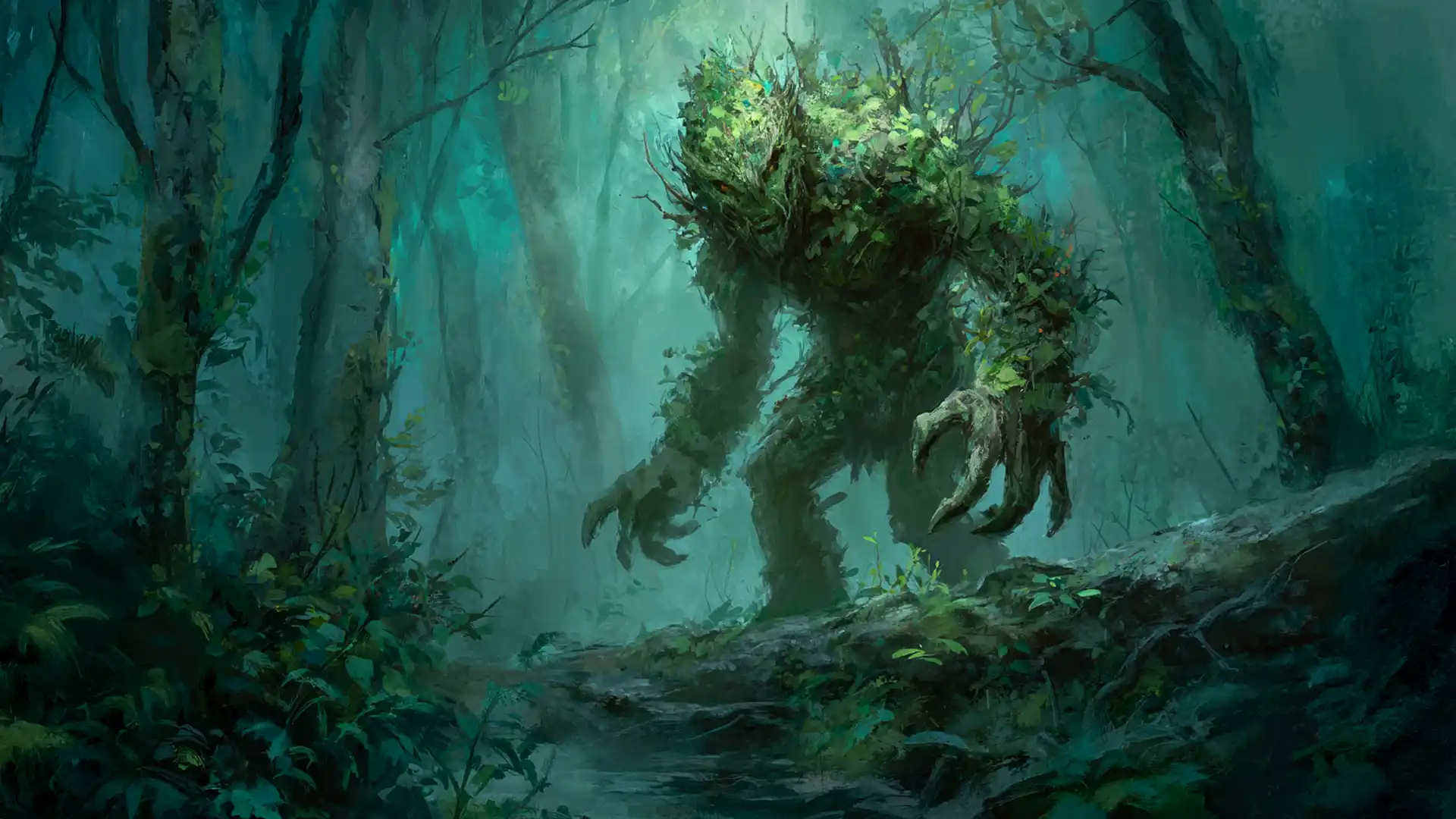
Bad Trolomor 🔍
| Large | Beast | Neutral | Level 9 |
How to encounter: |
In dense forest areas, except jungle areas. |
Armor Class: | 15 |
Hit Points: | 95 |
Speed: | 25 feet |
STR | DEX | CON | INT | WIS | CHA |
17 | 15 | 14 | 18 | 14 | 8 |
+2 | +3 | +2 | +3 | +1 | -1 |
Resistance: Dark Magic
Weakness: Fire damage
Skills: Arcana +5
Senses: Tremor Sense 120 feet
Languages: Druidic
XP Gain: 1100
Actions
Claw Swoop: Slashing attack, +6 to hit, reach 5 feet, Hit 16 (2d12+5).
With its large, branching claws, it makes a sweeping attack at its target.
Ivy Burst: Magic attack, +5 to hit, reach 15 feet, Hit 12 (2d10+5).
The Trolomor slams its fist on the ground. Releasing a darkened green magical burst affected anyone in its range.
Tree Throw: Bludgeoning attack, +2 to hit, reach 20 feet, Hit 11 (1d12+3).
With all its might, it rips a small-sized tree out of the ground and hurls it at you. Make a DEX 15 saving roll or be struck by the tree. If struck, you must roll once on each of the 4 tables on the Body Damage Table to determine your injuries.
Capturing Nature: The Bad Tromolor uses its natural magic to confine anyone in a 20 feet radius with branches of ivy. Make a DEX 14 saving roll or be confined. A STR 12 check or cutting action is required to free yourself.
Origin
Created by warring druids to fight their battles, these Bad Trolomors ironically led to their creators’ own demise, for they turned against them many years ago. Although it is somewhat rare to encounter a Trolomor, when you do, you do not want to be on its bad side.
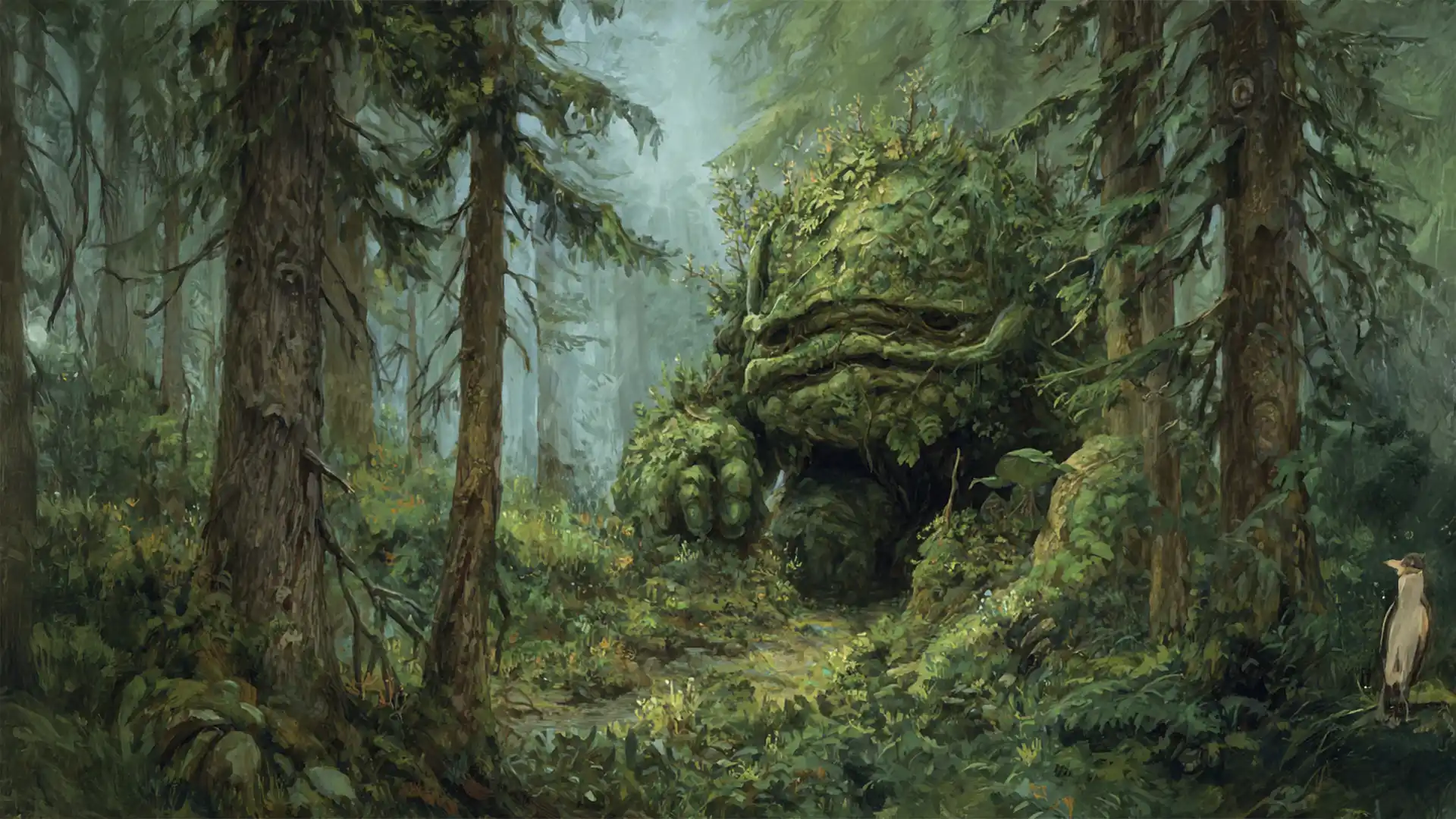
Good Trolomor 🔍
| Huge | Beast | Neutral | Level 10 |
How to encounter: |
In dense forest areas, except jungle areas. |
Armor Class: | 10 |
Hit Points: | 220 |
Speed: | 10 feet |
STR | DEX | CON | INT | WIS | CHA |
17 | 4 | 18 | 16 | 18 | 16 |
+3 | -3 | +4 | +3 | +4 | +2 |
Resistance: Dark Magic
Weakness: Fire damage
Skills: Arcana +7
Senses: Tremor sense 180 feet
Languages: Druidic, Common
XP Gain: 2000
Base Perks
❶ Enduring: For every point of damage it receives, it triples its magic charge. When the magic charge reaches 50 or more, it immediately releases a potentially deadly burst of magical damage equal to its charge level in a 30 feet wide circle. Creatures 15 feet away from the Trolomor can make a DEX 16 saving throw to take half damage.
Actions
Swing: Bludgeoning attack, +6 to hit, reach 10 feet, Hit 20 (2d20+2).
The Trolomor swings its large hand at the target, knocking it backwards unless it succeeds on a STR 14 saving roll.
Low Summersault: Area of effect attack, +6 to hit, range 20 feet, Hit 20 (2d20+2).
With its huge body, it performs a surprisingly vigorous low summersault, shaking the surrounding area as it crashes through thick branches and knocks over smaller trees. Make a DEX 15 saving roll or be struck by flying branches and falling tree debris.
Origin
These Trolomors were created as a line of defense against their evil counterparts. Often deemed a Forest Fortress due to their thick wooden exterior, slow movement, and towering height. These amazing creatures are kind and hold remarkable wisdom, if you can understand them. They have been known to show visions to those of Lawful Good alignment who possess the ability to speak with animals and handle them properly.